
Funkstown: Foggy Bottom’s Jewish Immigrant Grocery Stores
By Frank Leone
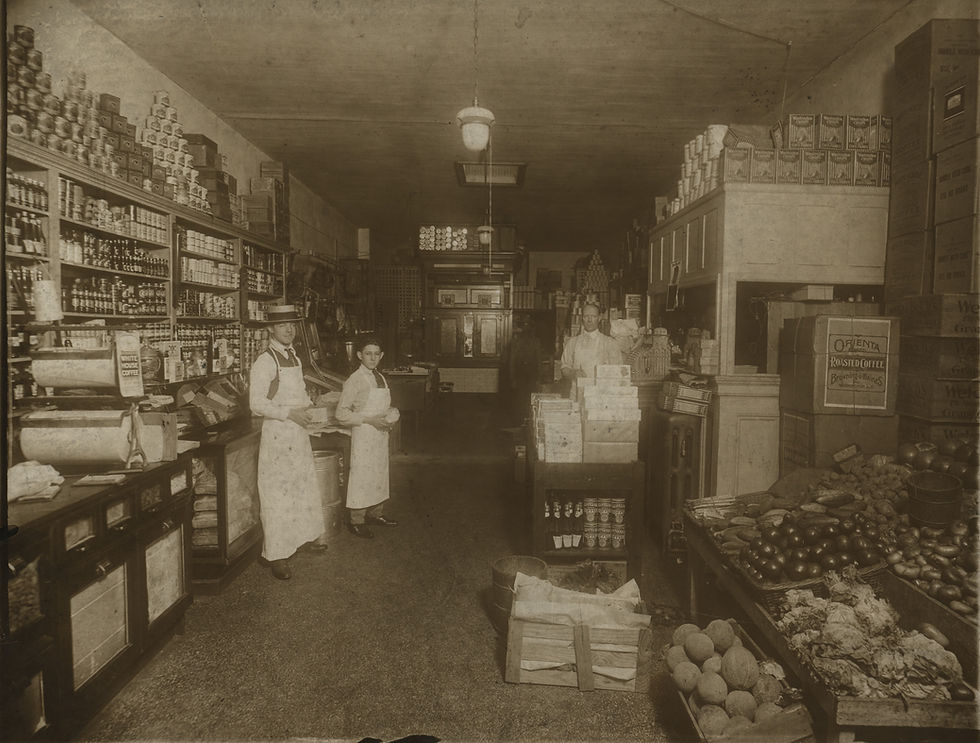
It’s virtually all residential today, but in 1920, the seven-block Foggy Bottom Historic District study area housed eleven grocery stores, many operated by Jewish immigrant families. Prior to zoning, the neighborhood featured a variety of businesses including corner grocery stores and saloons, as well as oyster bars, bakeries, hair salons, barbershops, dressmakers, and funeral homes (more about those in a later post). The neighborhood was what is now called a 15-Minute City (where all your needs are met within a 15 minute walk from your house).
Starting in the 1880s, Irish American and other families opened grocery stores. By the 1920s, many stores were operated by Jewish immigrants fleeing persecution in Russia/Poland and seeking economic opportunity. In 1920, grocery stores, often with families living above the stores, were operated at 2500 I St., 900 25th St., 933 25th St., 2639 I St., 844 New Hampshire Ave, 912 New Hampshire Ave., and addresses that no longer exist (2601 I St., 2700 K St., 962 26th St., 922 27th St., 948 27th St). By 1950, most stores closed as row houses were renovated or demolished and replaced by multi-unit buildings, and zoning changes made it difficult to open new stores.
The large yellow “Fitzgerald House” (844 New Hampshire Ave) operated as a grocery store starting in 1895. It was owned by Irish immigrants James and Catherine Fitzgerald and called the M&J Market (named after their children Mary Catherine (1899-1987) and James Desmond (1898-1965)).. When James died in 1899, Catherine operated it but by 1916 she rented the store and moved to a boarding house she ran on nearby 23rd Street. Grocers operating the store included Jewish Russian immigrants Gladstone and Dora Shoul (1915), Nathan and Anna Book (1920) (formerly a cigar maker), Isidore and Bessie Permut (1920-1924), and Samuel and Ida Chernikoff, who lived there with their three daughters, including Esther (a typist) (1935-1937). Chernikoff had a brother also known as Samuel and both were born in Russia in 1880s and arrived in America in 1914. Both spoke English and could read and write, but there is no evidence that they became citizens. Our Samuel went to work for his father-in-law, a grocer. The brothers operated about seven grocery stores around DC at different times until their deaths around 1950. In 1950, Jesse S. Shiwa, who was born in Okinawa, Japan, and his family lived there and operated the store.
Foggy Bottom was not unusual as many neighborhoods had “corner grocery stores” operated by Jewish families who immigrated in the late 19th early 20th century. The grocery stores offered an opportunity to start a business for Irish and Scottish immigrants in the mid-1980s, and when these early shopkeepers moved on, first German, then Eastern European Jews took over. The newer immigrants relied on financial support from the DC Hebrew Free Loan Society and family members or fellow villagers who had preceded them in reaching America. By 1924, there were 300 such stores citywide.
A GWU thesis that looked at Southwest DC neighborhoods describes life in these stores that applies as well to the Foggy Bottom stores. They were family enterprises in which they all worked six and half days a week (except Sunday afternoons). Many of the stores, like the neighboring residences, lacked indoor plumbing, electric lights or heating, and used coal stoves. Many were in neighborhoods like Foggy Bottom where most customers were African American. The stores provided food to the neighborhood and often extended credit (“on the book”) and in turn depended on their customers for income. Relations appear to generally have been cordial, but sometimes there was mistrust between storekeepers and customers. In some cases, the children of store owners and customers did not mix, but in others they played ball together.

Although most neighborhood businesses were gone by the 1950s, some remained. Henry and Stella Rosenblatt operated the Rosenblatt Market at 2500 I St. (now 830 25th St.) from 1939 to the early 1950s, when it moved across K Street to 25th and K (NE corner). Henry was born in Pennsylvania, but his father was a Russian immigrant. When Henry died in 1968, Stella continued to operate the market, but it closed by 1979. Alexander’s Market operated at across the street (2428 I St.) but closed by 1959. There was also a grocery store at the corner of 25th St. and the entrance to Snows Court (931-933 25th St.). Frank Rosenfeld operated it as the Plaza Food Market from 1958 and from 1971 to 1979, it was The New C&B Grocery and Delicatessen. The D&W Market operated from 1952 to 1969 at 26th and K (NW corner) and advertised in the Foggy Bottom News.

The only remaining market is the 7-11 store (912 New Hampshire Ave.), built in 1876 and one of the oldest buildings in the Historic District. By 1887 German Catholic immigrant Theodore Ruppert operated a grocery store but lost his liquor license in 1896 and subsequently moved. Russian Jewish immigrant Anna Kolker ran the store in the 1920s-1930s. (17-year-old Jacob Kolker was arrested for violating prohibition laws in 1923 for selling illegal cider, but he later became a lawyer and moved to New York.) Flora Rubenstein ran the store (then called the New England Market) in the 1940s. By 1963 it was Nichols Food Superette, and it became a 7-11 store in 1982 (over some neighborhood objections, although the store operation was reduced from two to one story). Which grocery stores do you remember in the Historic District?
Thanks to the Capital Jewish Museum! Sources: Abrams Kolker, “Migrants and Memories,” GW University Ph.D. Thesis, 1997; Jane F. Levey, “Counting Change: The Old Southwest of Clarice Chasen Smith,” Washington History, 3:2, Fall 2022; Laura Cohen Applebaum & Wendy Thurman, Eds., Jewish Washington: Scrapbook of an American Community, Jewish Historical Society of Greater Washington, 2007; Jessica Kaz,“Half a Day on Sunday: Jewish-Owned ‘Mom and Pop’ Grocery Stores,” The Record, 20:1-12, 1993-1994; “Washington’s Jewish Community – Separate But Not Apart,” in Francine Curro Cary, Urban Odyssey – A Multicultural History of Washington, D.C., Smithsonian Press,1996; Oral History: GWU Interviews of James Briscoe/W. David Riley – Dec. 5, 2011– Foggy Bottom in the 1950s and 1960s; Foggy Bottom News; U.S. Census 1910-1950; Boyd’s Directory of Washington DC (1920-1950); Ancestry.com; FBA History Project.


Comments