
Funkstown – Foggy Bottom’s Own Fire Engine Company No. 23
By Frank Leone
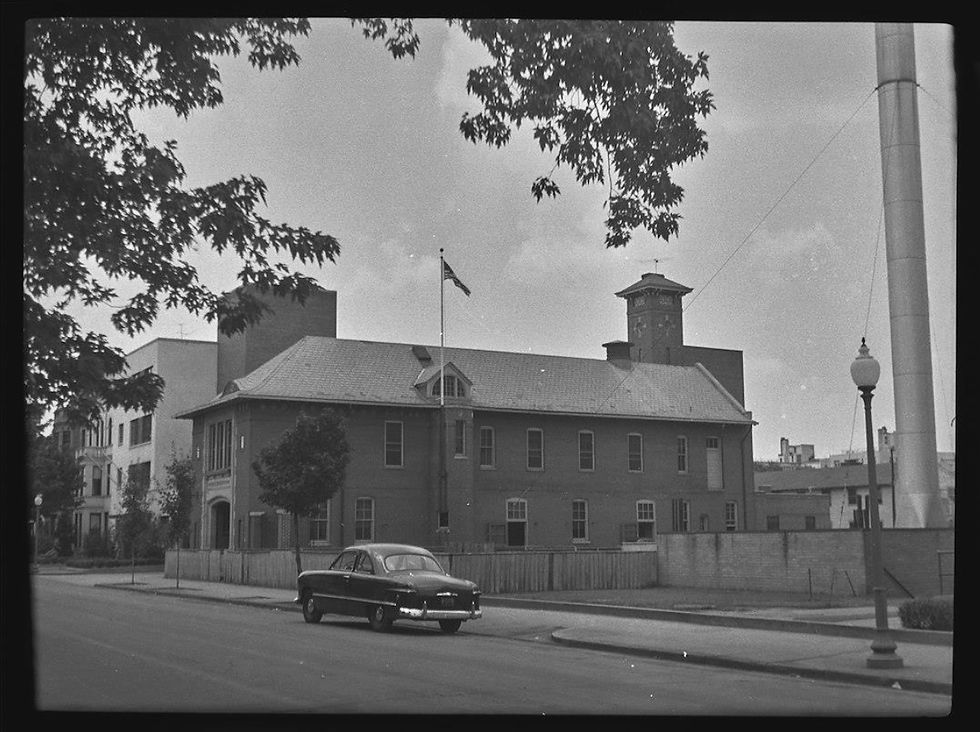
Foggy Bottom boasts the smallest firehouse in Washington, D.C. and it has had to fight to keep its treasured landmark. Engine Company No. 23 sits in the heart of George Washington University (2119 G Street). Built in 1910, the building is a modest, two-story red brick firehouse featuring an Arts and Crafts interpretation of the Italian Renaissance Revival style. It was intended to foster civic pride as well as protect the community. The firehouse is a contributing building to the George Washington University/Old West End Historic District.

The firehouse was designed by prominent local architects Joseph C. Hornblower & James Rush Marshall and D.C. Municipal Architect Snowden Ashford to be compatible with surrounding residential buildings. It measures approximately thirty-five feet wide by ninety feet deep and allows fire engines to be “stacked” (one behind the other) rather than side by side, as in most stations. It was the last firehouse to be organized as a horse-drawn engine company and the horses were stabled at the back of the building, with a hayloft upstairs. It may be the only firehouse in the city with spiral staircases, which were intended to prevent horses from climbing up to the hay. The building also features a 60 foot “watchtower” where fire hoses (then made of cotton canvass) were hung to dry.
Identified for sale in 1940, the neighborhood protested and saved the building for its original purpose. Forty years later, in the early 1980s, neighbors, GWU students, the DC Firefighters Association, the Advisory Neighborhood Commission, and Councilmember John Wilson successfully fought the mayor’s effort to close the station, arguing it was vital to the safety of the neighborhood. It was again targeted for closure in 1996, but the community again was able to save it. The community has long supported the fire station, with Foggy Bottom resident Elle Becker (1932-2015) providing regular pot roasts to the crew. Like other firehouses, ours serves as a “Safe Place” for young people needing help.
In 2022, the fire station underwent a nine-month, million-dollar renovation including an upgraded fire pole, sleeping quarters, lighting, kitchen equipment, HVAC operations, ventilation equipment, a new lactation room and high-tech alerts in sleeping areas.
Fire-fighting has a long history in Washington D.C. The first companies were volunteer and functioned like social clubs. Intense rivalries between volunteer fire companies sometimes led to physical fights, often over which company would respond to a fire first. The first paid fire units were organized in 1864 and the force transitioned to a fully professional fire department in 1871. Following the Civil War, D.C. connected its first telegraph red “Call Boxes” to the Fire Department (and blue Police Department call boxes). Later replaced by telephone lines and then abandoned, several call box structures remain in Foggy Bottom, including at 25th and I Streets.

Long before Engine Co. 23, Foggy Bottom was the home of the Union Engine Fire House (SW corner of 19th and H Streets), built in 1832 and demolished in 1956 to make way for the International Monetary Fund building. The second floor was was used for church services in the later 1800s, and housed the Association of the Oldest Inhabitants of D.C. from 1911 to 1956. The West End is currently serviced by Engine Co. No. 1 at 2225 M Street (originally at 1643 K St). Built in 2015, the fire station shares a mixed-use building with condominiums and a squash club.
Sources: “Engine Company No. 23,” DC Historic Sites; EHT Traceries and District of Columbia Historic Preservation Office, George Washington University/Old West End Historic District Nomination, 2013; D.C. Historic Preservation Office, Fire Houses in Washington D.C. Context Study, 2021; DC Fire & EMS Foundation, History; Kristi King, WTOP, “Historic District Firehouse Gets 21st Century Upgrade,” Feb. 14, 2022; Zach Blackburn, “D.C. FEMS commemorates campus firehouse reopening with ribbon-cutting ceremony,” GW Hatchet, February 17, 2022; Tom Precious, “Public Pressure Wins Reprieve,” Washington Post, March 4, 1982; Mary E. Healy, “Move ‘em Out,” Foggy Bottom News, Sept. 1978; The Capital Fire Museum, Firefighting in Washington, D.C., Arcadia, 2004; FBA History Project.


Comments