
Funkstown – Yes, There is Art Deco in Foggy Bottom
By Frank Leone
Foggy Bottom is known for its Victorian brick rowhouses, some with faux Federalist features. But Steve Knight, president of The Art Deco Society of Washington, recently led a tour highlighting Art Deco (and Art Deco-adjacent) buildings in Foggy Bottom. The tour started at the one of the D.C.’s most beautiful buildings, the National Academy of Sciences, whose “Alexandrian” design fused Greek, Byzantine, Egyptian, and Art Deco elements. Many of the buildings on the tour itinerary are contributing properties to the George Washington University/Old West End Historic District or GWU buildings outside of its boundaries, but nevertheless designated as D.C. Historic Landmarks as part of the GWU 2007 Campus Plan.
According to the Art Deco Society of Washington, “Art Deco is an influential visual arts design style which first appeared in France after World War I, flourishing internationally in the 1920s, 1930s and 1940s. It is an eclectic style that combines traditional craft motifs with Machine Age imagery and materials. The style is often characterized by rich colors, bold, often streamlined, geometric shapes, and stylized ornamentation.”

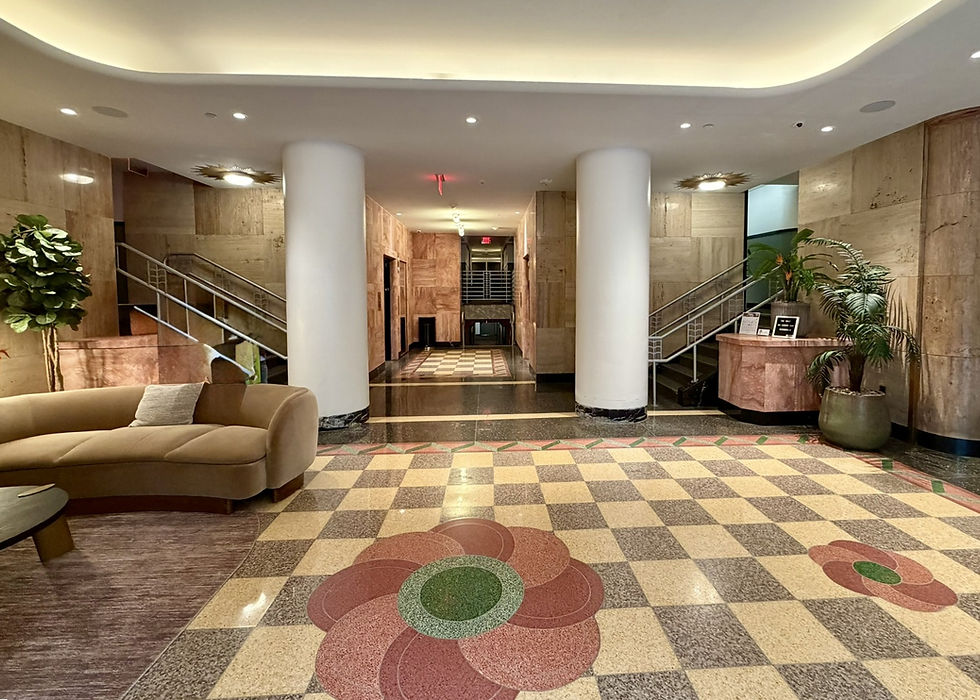
The Wray (515 22nd St.), built as the Park Manor Apartments in 1940, is a contributing building to the GWU/Old West End Historic District. Its architect was Roger G. Moore, and it was renovated by Robert C. Smith. Although intended to house residential apartments, it never did so. The U.S government acquired the eight-story (100,000 square foot) building during World War II for the State Department (Annex 2 building). In 2019, developers (Insight Property Group in partnership with ELV Associates) bought the building, and opened it as the 158-unit luxury rental apartment building in 2021. The project preserved the historic Art Deco lobby and façade while adding modern amenities and a new penthouse structure on the roof.
The GWU Medical Facilities Associates (H.B. Burns Memorial) Building (2150 Pennsylvania Ave.) was built as The Keystone apartment building in 1931. The twelve story “D.C. Skyscraper” was designed by architect Robert O. Scholz (1895–1978), a leading DC Art Deco designer. GWU acquired the building and in 1971 dedicated it as a clinic in honor of H.B. Burns, the deceased brother of GWU Trustee and donor Jacob Burns. It is not included in the GWU/Old West End Historic District but was separately designated as a D.C. Historic Landmark in 2010.
When built during the depression, the Keystone provided affordable housing for middle class residents. Many residents were young singles or married couples, and worked for the government, typically in lower-level white collar jobs. One of the largest D.C. apartment buildings at the time of completion, the Keystone helped establish Foggy Bottom as a prime location for middle-class households. The exterior of the building is faced with yellow brick, limestone, and cast stone (concrete). Metal panels that feature decorative scrollwork are found below the windows and above the main entrance.

Architect Scholz also designed in the Art Deco style two nearby former eight-story, one bedroom/efficiency apartment buildings: Munson Hall (1937, 2212 I St.) and Jackie Bouvier Kennedy Onassis (JKBO, originally Milton) Hall (1938, 2222 I St.). GWU purchased the buildings for use as dormitories in 1971 and 1981. Their style influenced Joseph Abel who designed J. William Fulbright Hall (2223 H St.), originally the Everglades Apartment Building, built in 1939, GWU acquired it in 1949 for use as a nursing dormitory. All three buildings were designated as D.C. Historic Landmarks in January 2010 as part of GWU’s 2007 Campus Plan.
Sources: [Special thanks to Steve Knight and the Art Deco Society of Washington for their tour, building descriptions, and general information, and Alana Quinn of the NAS.] Richard Striner and Melissa Blair, Washington and Baltimore Art Deco, Johns Hopkins Univ. Press, 2014; The Wray, Our Story; Keystone Apartment Building, National Register Nomination Form, 2006; DC Preservation League, DC Historic Sites, The Keystone; DC Architects Directory, Robert O. Sholz; FBA History Project.


Comments