
Funkstown - Visiting Foggy Bottom’s DAR Memorial Continental Hall

By Frank Leone
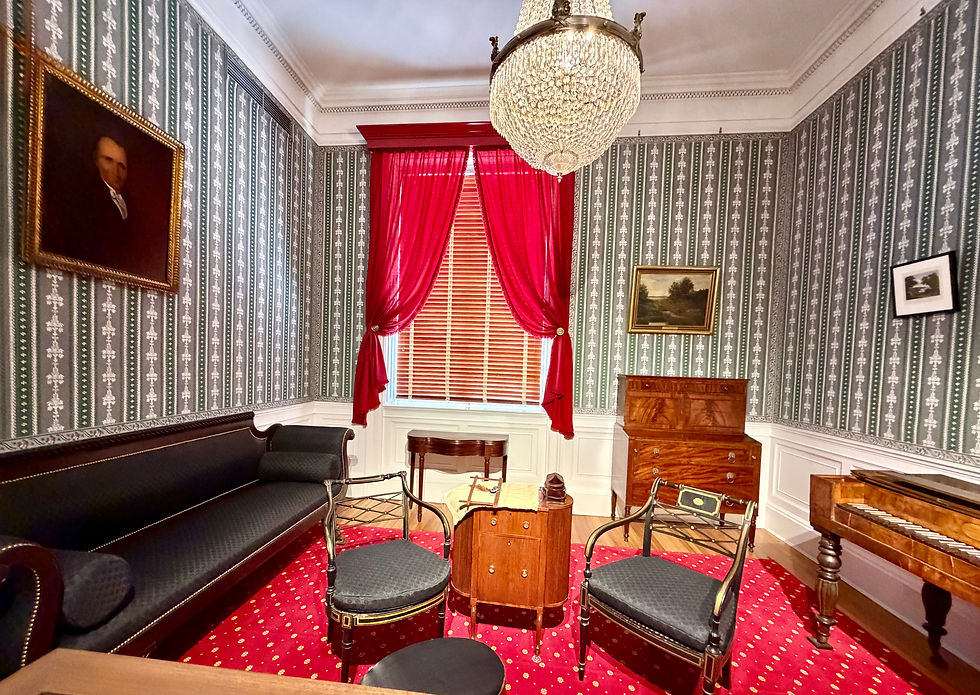
In 1902, the Daughters of the American Revolution (DAR), a patriotic organization composed of female decedents of those who served in the American revolutionary war, were seeking a home. After considerable research, they purchased undeveloped marshy Foggy Bottom Square 173 – bounded by 17th and 18th, C and D streets. Their first building was Memorial Continental Hall on 17th Street. Built in 1904-10, it serves as both the DAR headquarters and a Revolutionary War memorial. It also houses an extraordinary library, museum, Americana collection/Archives, and “period rooms” decorated by state organizations. You can take a free tour led by knowledgeable docents. The DAR constructed an adjoining administrative building in 1920 (expanded in 1950). The ensemble was completed by the construction of the better-known DAR Constitution Hall in 1929. That building, designed by John Russell Pope, is still D.C.’s largest concert hall.

The DAR was founded in 1890 for patriotic, historic, and educational purposes by four women whose predecessors served American Revolution. The DAR founders sought to create an organization that would "perpetuate the memory and spirit of the women and men who achieved American independence." It had a segregationist past and is known for its exclusion of African American signer Marion Anderson in 1939 – an exclusion that was remedied by Eleonor Roosevelt, who resigned her membership and arranged for Ms. Anderson’s famous performance at the Lincoln Memorial. (See our Department of Interior building post for more on that controversy.) The DAR subsequently changed its policies and Ms. Anderson sang at Constitution Hall six times after 1939. The organization is now open to all racial groups.
Memorial Hall was designed by architect Edward Pearce Casey in a Georgian Revival/Beaux Arts style. (Casey was involved with the interior design of the Library of Congress Jefferson Building.) Built of brick and concrete, Memorial Hall is clad in Vermont marble and contains classical motifs (including many columns). Its design was consistent with the McMillan Commission’s “White City” concept. The 35,000 square foot building contained an auditorium (now the library), offices, library, museum and dining rooms. It is currently undergoing restoration, which included removal of gold paint that had turned brown and a return to original colors.

The DAR Library collection contains over 225,000 books, 10,000 research files, thousands of manuscript items, and special collections of African American, Native American, and women’s history, genealogy and culture. The library contains nearly 40,000 family histories and genealogies. The library is free and open to the public.
The hall has witnessed several historical events. In 1921, in response to the devastation of the War to End All Wars (WWI) and an ongoing arms race, the principle naval powers of the world met in the hall’s auditorium (now library) for Washington Naval Conference. President Warren Harding opened the conference, with the goals of reducing the size and armament of their navies and ensuring security in the Pacific. The conference, led by U.S. Secretary of State Charles Evans Hughes, agreed to the world’s first arms limitation treaties, which stabilized the naval arms race until Japan withdrew in 1936. This gathering provided the basis for the designation of the hall as a National Historic Landmark in 1972.
The building served as the final meeting place of the 1913 Woman Suffrage Procession, initiated by Alice Paul. During World War II Memorial Continental Hall became the site of many Red Cross offices, including space for its Prisoners of War offices. The DAR also sponsored a War Service Center located in the Hall, which was open for WWII servicemen six days a week. The hall provided film locations for nine episodes of West Wing (the N.H. DAR chapter is named for Josiah Bartlett), as well as House of Cards, Veep and other television shows and movies.
Sources: DAR Website; DAR National Headquarters Building History; National Park Service, DAR Memorial Continental Hall National Register Nomination, 1972; The National Society Daughters of the American Revolution, In Washington: DAR Memorial Continental Hall, 1965; FBA History Project.


Been using text-to-panorama AI for greybox stage on client pitches.
Not photoreal enough for final renders, but saves a day per concept when I just need a believable env to drop a building into.