
Funkstown – A New Deal with Interior Art
By Frank Leone
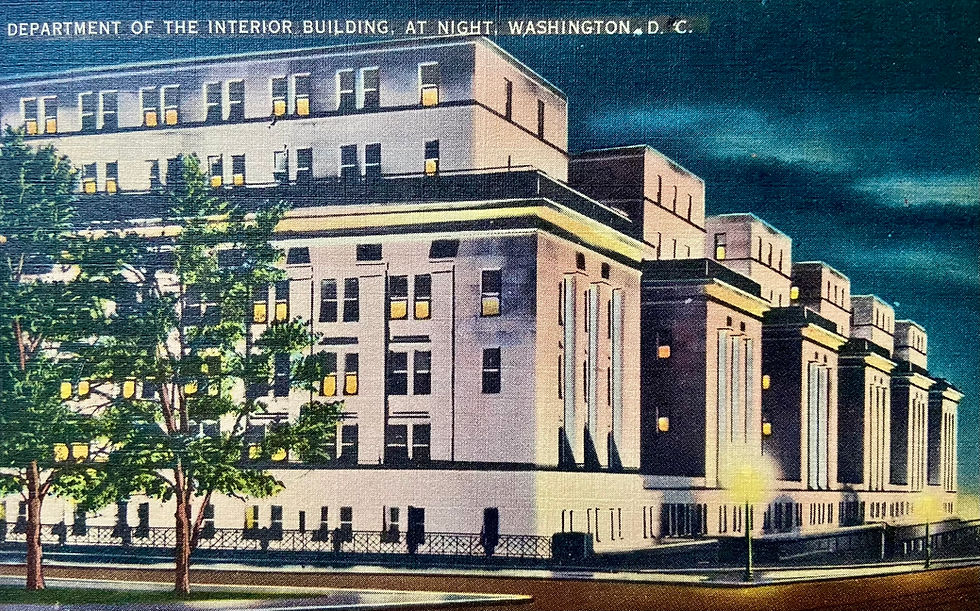
The massive Udall Department of the Interior building (1849 C St. NW) was the first of the New Deal generation of federal buildings. The Interior headquarters features more New Deal era artworks than any other Federal building – they can be viewed by calling to reserve a free tour (Tuesday and Thursdays at 2 pm).
The Department of the Interior was founded in 1849, supplementing the Departments of State, Treasury, and War, and acting as “a department of everything else.” The Department oversees agencies including the National Park Service, Historic Preservation, Fish and Wildlife, Land Management, Mining, and Bureau of Indian Affairs. (Like most Federal agencies, Interior has experienced significant budget cuts under the current administration.)
From 1812 to 1917, Interior was located in the U.S. Patent Office building (now the Smithsonian’s Center for American Art and Portraiture). It relocated to a new building in Foggy Bottom that now houses the General Services Administration (1800 F St. NW). Outgrowing that space, Harold L. Ickes (1874–1952), Secretary of the Interior from 1933 to 1946, envisioned a new large, functional and innovative federal building – “a symbol of a new day” during the Great Depression.
Ickes was actively involved in the building’s design and decoration, and the contemporary press referred to the building as Ickes’ new home. (He received some criticism for the blue tile he chose for the Secretary’s bathroom.) Ickes personally selected local architect Waddy Butler Wood (1896–1944), who enjoyed a distinguished and prolific career in Washington. The building included innovations including central air conditioning, an automatic fire sprinkler system, a gymnasium, and a radio station.
The stripped classical style building features a one-story projecting base, clad in Milford pink granite (from Massachusetts). Above, the building is clad in blocks of buff Indiana limestone – Secretary Ickes objected vigorously to traditional classical columns. Although not excessively ornate, the building includes art deco features, including a streamlined Westinghouse escalator (a first for a federal building).

Secretary Ickes wanted to decorate the building with artwork that would remind workers of the Department’s mission (and he sometimes micro-managed the process). The building houses nearly 50 works of art (here) most of which were funded through New Deal programs (specifically the Treasury Section on Fine Arts). The murals (oil on canvass, fresco, and secco) and sculptures depict the Department’s resource exploitation and conservation efforts and Native American ways of life (including works by six native artists). The building also displays 26 Ansel Adams photographs of parks, people, and progress from 1940-1941.
The building includes a small museum that is open to the public, no reservation needed. It contains two amazing Thomas Moran landscapes, artifacts, and displays that describe the Department’s work. Across the hallway is the “Indian Crafts Shop” which closed in 2025 and is awaiting new management. Also, look around the library (off the entrance hall) and its antique clock and card catalog.

The building was renamed in 2010 to honor Stewart Lee Udall (1920–2010), who served as Secretary of the Interior from 1961 to 1969. The main entrance overlooks Simon Bolivar Park (built 1957), part of Foggy Bottom’s “Avenue of the Americas.” The north entrance at E Street overlooks Rawlins Park. Interior is an important structure in Foggy’ Bottom’s “Northwest Rectangle.”
You can find out more about New Deal architecture and art through The Living New Deal’s website and DC map and guide. The current administration plans to sell several federal buildings, some of which contain New Deal era artwork. The Wilber Cohen Social Security Building, sometimes called the Sistine Chapel of New Deal murals, is particularly under threat – find out how to help HERE.
Sources: General Services Administration, Interior Department Building History; US Department of Interior, History of the Main Interior Building; US Department of the Interior, History of the Department of the Interior; Living New Deal, Udall Department of Interior Building; David W. Look, Carole L. Perrault, and United States National Park Service Preservation Assistance Division, The Interior Building: Its Architecture and Its Art, Washington, DC: U.S. Dept. of the Interior, 1986; FBA History Project.


Comments