

Funkstown - Visiting Foggy Bottom’s Moons of Mars

By Frank Leone
Unlikely as it may seem, the original U.S. Naval Observatory was located here in Foggy Bottom, on “Observatory Hill,” across 23rd Street from the State Department. There in 1877 astronomer Asaph Hall, using the biggest telescope in the world, discovered the two tiny moons of the planet Mars. The potato-shaped moons Phobos (“Fear”) and Deimos (“Dread” or “Terror”) have mean diameters of 14 and 7.8 miles. (The moons were named for the sons of Mars, the Roman god of war.) The new Mars Moons eXploration (MMX) mission launched on October 20, 2026 will visit Phobos, take samples, and return them to Earth for analysis.

In 1825, President John Quincy Adams first asked Congress to fund a national observatory, “a light house of the sky.” It was not until 1844 that the Naval Observatory, including a 9.6-inch (diameter mirror) refracting telescope, was established. But Foggy Bottom was not the ideal location for an observatory. The Potomac’s tidal marshes generated fog and harbored mosquitoes, exposing the Observatory staff to malaria. Factory smoke would sometimes obscure the sky and traffic would shake the instruments. Thus in 1893, the Naval Observatory moved to its current location (3450 Mass. Ave. NW, near the U.S. Vice President’s residence; the site is not open to the public (although I did visit the observatory before the Vice President moved in 1977).
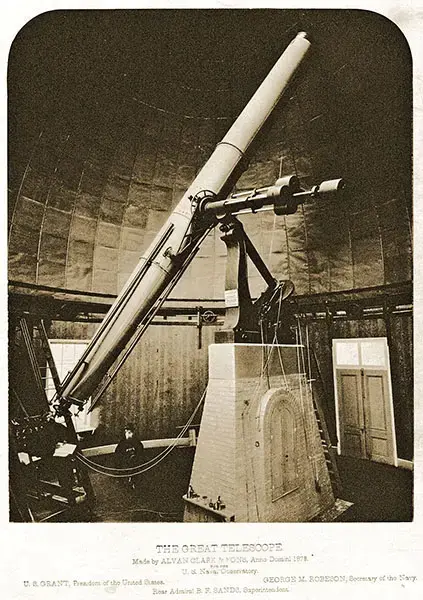
Astronomer Asaph Hall (1829-1907) joined the Naval Observatory in 1862. His wife, Angeline Stickney Hall (1830 – 1892), a gifted mathematician (who had been his professor at New York Central College), worked as his unpaid assistant. (The 5.6-mile-long Stickney Crater on Phobos is named in her honor.) In 1873, Hall took charge of the new “Great Equatorial” refracting telescope with a 26-inch mirror, the largest in the world. Hall had regular observing work to do, but in his spare time, he used the telescope to look for moons around Mars, which had been suspected (other planets had moons), but never observed.
During Mars's closest approach in 1877, Hall was encouraged by his wife to search for the Martian moons. He first saw one on August 11 at 2:30 am, but then lost it in the fog. On Aug. 17, he relocated that moon, and identified another larger one. The observations were soon confirmed by other observatories and hailed as a major astronomical discovery.
Now the Martian Moons are the target for up close exploration with the Japan Aerospace Exploration Agency (JAXA) MMX mission. The extraordinary mission should reach Mars in the Fall 2027. The spacecraft will orbit Phobos for several years, capturing images and spectra to learn about its composition and structure, and conduct a flyby to observe Deimos. The craft will deploy a small four–wheeled rover to scout the terrain, study surface properties, and gather data. The main lander will then collect 10 grams of rocks and grains and deliver it to the craft to send to Earth for in-depth analysis. The spacecraft with the soil sample is scheduled to land in Australia in 2031.
As a small moon of Mars that has not undergone the same geologic evolution of the planets, Phobos preserves evidence of the early evolution of the Mars system, allowing investigation of the planet's environmental evolution and the processes of formation of a habitable planet. The mission may resolve the dispute about whether the moons are left over from Mars’ formation or are captured asteroids. This in turn may answer questions about how the solar system assembled and how life-giving water and organic molecules reached Earth.

For more on the Observatory and the long history of what is now called Potomac Hill, see Funkstown: Foggy Bottom Discovers the Moons of Mars. Thomas Mallon, who resided within sight of the observatory at 801 25th Street in the Historic District (previously the home of architect Melita Rodeck) wrote an excellent historical novel, Two Moons, that discusses these events. This NASA JPL video, taken from the surface of Mars by NASA’s Curiosity Rover in 2013, shows Phobos eclipsing Deimos.
Sources: Jan K. Herman, A Hilltop in Foggy Bottom: Home of the Old Naval Observatory and the Navy Medical Department, 4th Ed., U.S. Bureau of Medicine and Surgery, 1996; DC Preservation League, Observatory Hill Historic District; Angelo Hall, An Astronomer's Wife: The Biography of Angeline Hall, Nunn & Co., 1908; William B. Ashworth, Jr., “Scientist of the Day: Asaph Hall,” The Linda Hall Library, Oct. 15, 2024; Dr. Ari Koeppel, “The New Faces of Mars,” The Planetary Report, Sept. 2026; JAXA, Martian Moon eXploration; FBA History Project


Comments